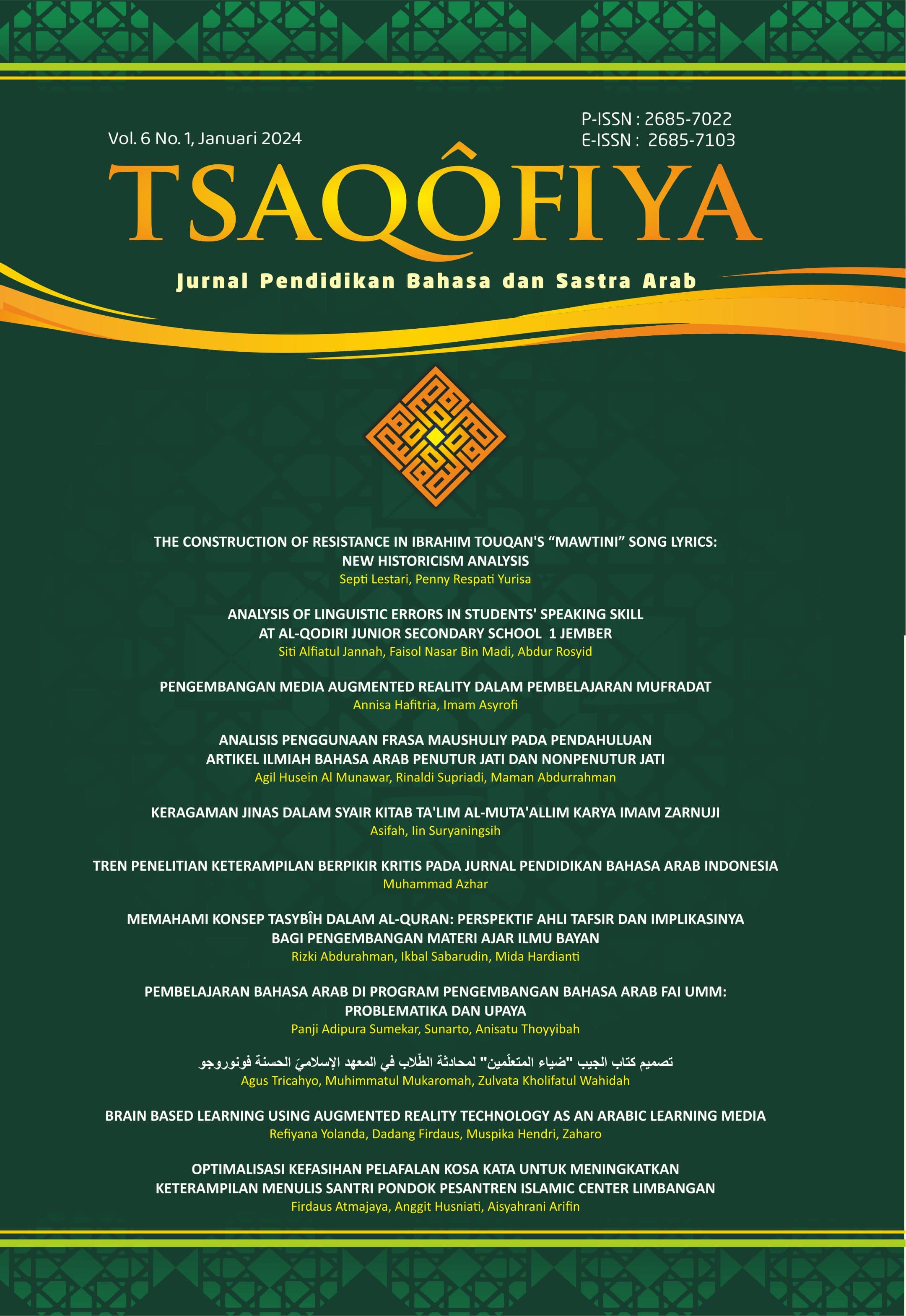
The Construction of Resistance in Ibrahim Touqan's “Mawtini” Song Lyrics: New Historicism Analysis
DOI:
https://doi.org/10.21154/tsaqofiya.v6i1.427Keywords:
resistance, mawtini’s song, new historicismAbstract
The hegemonic attempts made by the British and European Jews triggered resistance from the Palestinian people. The resistance is manifested in physical and non-physical struggles, including literary works. This research aims to reveal the construction of resistance in Ibrahim Touqan's Mawtini by using the theory of New Historicism by Stephen Greenblatt. Literary readings are juxtaposed with non-literary texts in order to find the historical background of colonialism in Palestine in the British Mandate era and the diaspora of Jews from Europe. This research is a descriptive qualitative type. The data of this research is in the form of mawtini song lyrics which are then read together with two non-literary books to understand the historical substance behind the song lyrics. Based on the results of the research, it was found that the construction of resistance in this song is structured through the perspective of the people seeing their homeland, the hope for a resolution to the conflict, the importance of the role of youth to fight, the purpose of the resistance and the methods taken in resistance to hegemony efforts over the land of Palestine.
Abstrak
Upaya hegemoni yang dilakukan oleh Inggris dan Yahudi Eropa memicu perlawanan dari rakyat Palestina. Perlawanan tersebut diwujudkan dalam perjuangan fisik dan non-fisik, termasuk di dalamnya adalah karya sastra. Penelitian ini bertujuan untuk mengungkapkan konstruksi perlawanan di dalam lirk lagu Mawtini karya Ibrahim Touqan dengan menggunakan teori New Historicism oleh Stephen Greenblatt. Pembacaan sastra disandingkan dengan teks non sastra agar menemukan latar belakang sejarah kolonialisme di Palestina di era Mandat Inggris serta diaspora kaum Yahudi dari Eropa. Penelitian ini berjenis kualitatif deskriptif. Data penelitian ini berupa lirik lagu mawtini yang kemudian dibaca bersamaan dengan dua buku non-sastra untuk memahami substansi sejarah di balik lirik lagu tersebut. Data dikumpulkan menggunakan teknik baca-catat. Sedangkan teknik analis data melalui tahap reduksi data, penyajian, dan penarikan kesimpulan. Berdasarkan hasil penelitian, ditemukan konstruksi perlawanan di dalam lagu ini disusun melalui perspektif rakyat melihat tanah airnya, harapan adanya resolusi atas konflik, pentingnya peran pemuda untuk melakukan perlawan, tujuan dari perlawanan tersebut serta cara-cara yang ditempuh dalam melakukan perlawanan terhadap upaya hegemoni di atas negeri Palestina.
Downloads
References
ABDUL MOULA, Hossin. “Hayden White’s Theory of History as Narrative in the Light of New Historicism.” Eurasian Journal of English Language and Literature 5, no. 1 (2023): 27–39.
Abdussamad, Zuchri. Metode Penelitian Kualitatif. Edited by Patta Rapanna. Makassar: Syakir Media Press, 2021.
Abu-Ghazaleh, Adnan. Arab Cultural Nationalism in Palestine during the British Mandate. Beirut: The Institute for Palestine studies, 1973. https://doi.org/10.2307/2535866.
Adhitya, Reza Taufan, Renny Anggraeny, and Ida Ayu Laksmita Sari. “Representasi Sejarah Dan Dampak Perang Dunia II Dalam Komik Kono Sekai No Katasumi Ni Karya Fumiyo Kouno.” Diglosia: Jurnal Kajian Bahasa, Sastra, Dan Pengajarannya 4, no. 2 (2021): 189–204. https://doi.org/10.30872/diglosia.v4i2.178.
Al-’Udat, Ya’kub. Ibrahim Tuqan Fi Wataniyyatihi Wa Wijdaniyyatihi (The National and Emotional Poetry of Ibrahim Tuqan). Beirut, 1964.
Annisa, Adellia Ifha, Ahmad Bachmid, and Ahfa Rahman Syah. “A Poem Mawtini as Unofficial National Anthem of Palestine by Ibrahim Tuqan. The Michael Riffaterre’s Semiotic Lens.” LITTERATURA: Jurnal Bahasa Dan Sastra 2, no. 1 (2023): 45–60. https://doi.org/10.15408/ltr.v2i1.30069.
Artika, I. W. “Pengajaran Sastra Dengan Teori New Historicism.” Prasi: Jurnal Bahasa, Seni, Dan Pengajarannya 10, no. 20 (2015): 50–55. https://doi.org/https://doi.org/10.23887/prasi.v10i20.8917.
Awais, Ihab Ahmed. “The Conceptual Development of the Palestinian National Identity.” Journal of Humanities and Social Science 24, no. 11 (2019): 69–79. https://doi.org/10.9790/0837-2411076979.
Aziz, Muhammad Abdu. “الوطنية في شعر حسن فتح الباب.” مجلة علمية سنوية محكمة, no. 1 (2015).
Barry, P. Beginning Theory: An Introduction to Literary and Cultural Theory. Manchester: Manchester University Press, 2020.
Budianta. “Budaya, Sejarah, Dan Pasar: New Historicism Dalam Perkembangan Kritik Sastra.” Susastra Jurnal Ilmu Sastra Dan Budaya 2, no. 3 (2006): 1–19.
Hasibuan, Sammad. “Nasionalisme Dalam Puisi ‘Hanȋn’ Karya Ahmad Rami Dan Faruq Juwaidah (Sebuah Tinjauan Intertekstualitas).” Tsaqofiya : Jurnal Pendidikan Bahasa Dan Sastra Arab 4, no. 2 (2022): 223–42. https://doi.org/10.21154/tsaqofiya.v4i2.99.
Hughes, Matthew, and Allenby. British Strategy in the Middle East 1917-1919. London: Taylor & Francis, 1999.
Insani, Hermawati Putri Dian. “Fakta Sosial Perang Lebanon Tahun 1982 Dalam Lagu a’Tuna Tufuli Karya Remi Bandali: Analisis Semiotik Riffaterre.” Jurnal CMES Volume XIV Nomor 1 Edisi Januari – Juni 2021 XIV (2021): 69–79.
Kiani, H, Mir Qadiri, SFA. “IbrahimTuqan Martyrs and Veterans in Poetry.” Loterature Publication Stability 1, no. 1 (2009): 128–42.
Murdiyanto, E. Metode Penelitian Kualitatif (Teori Dan Aplikasi Disertai Contoh Proposal). Yogyakarta: UPN Veteran Yogyakarta Press, 2020.
Muslih, Muhammad. “Arab Politics and the Rise of Palestinian Nationalism,.” Journal of Palestine Studies 4, no. 16 (1987): 77–894. https://doi.org/10.2307/2536721.
Muttaqin, Khoirul. “Representasi Sejarah Pers Pada Masa Sebelum Dan Setelah Kemerdekaan Indonesia Dalam Novel Mencari Sarang Angin.” Jentere: Jurnal Kajian Sastra 10, no. 1 (2021): 17–31. https://doi.org/: https://doi.org/10.26499/jentera.v10i1.2903.
Nofrianti, Mami, and Kori Lilie Muslim. “Praktik Seksualitas Menyimpang Masyarakat Muslim-Minangkabau: Kajian Neo-Historisisme Terhadap Film Titian Serambut Dibelah Tujuh.” Jurnal Fuaduna: Jurnal Kajian Keagamaan Dan Kemasyarakatan 5, no. 1 (2021): 35–44.
Nurhadi. “Pembunuhan Massal Etnis Cina 1740 Dalam Drama Remy Sylado: Kajian New Historisisme.” Jurnal Pendidikan Dan Kebudayaan 14, no. 75 (2008): 1197–1225.
Nurhasanah, Ariyanti Rifa, Yoyo Yoyo, and Norfaezah Mohd Hamidin. “Independence in Ahmad Syauqi’s Poetry ‘Yā Ayyuhā As-Sāil Mā Al-Ḥurriyyah’ (New Historism Analysis).” Diwan : Jurnal Bahasa Dan Sastra Arab 7, no. 2 (2021): 226–46.
Palangsaraei, Farideh Akhavan, Mohammad Jannati Far, and Mohammad Hassan Masoomi. “Investigating the Symbol in the Poems of Resistance Ebrahim Touqan.” The Islamic University College Journal, no. 55 (2020): 5–22.
Paul, Starkey. Modern Arabic Literature. Edinburgh: Edinburgh University Press, 2006.
Podeh, Elie. “Anthems in the Arab World: A Hybrid National Symbol.” Nations and Nationalism 28, no. 4 (2022): 1379–94. https://doi.org/10.1111/nana.12803.
Purnamawati, Zulfa, Sangidu Sangidu, Fadlil Munawwar, and Taufiq Dardiri. “Ideologi Perlawanan Dalam Antologi Puisi Fī Ṭarīqi Al-Fajri Karya Abdullah Al-Baradduni.” Poetika 7, no. 1 (2019): 72. https://doi.org/10.22146/poetika.v7i1.44452.
Rahayu, Lina Meilinawati, and Aquarini Priyatna. “Upaya Resistensi Pada Rezim Represif Melalui Sastra Drama: Telaah Atas ‘Opera Kecoa’ Karya Riantiarno Dan ‘Perahu Retak’ Karya Emha Ainun Najib (Resistance Efforts towards the Repressive Regime: Study on Riantiarno’s ‘Opera Kecoa’ and Emha Ainun Najib’s ‘.” Lensa: Kajian Kebahasaan, Kesusastraan, Dan Budaya 9, no. 2 (2020): 120. https://doi.org/10.26714/lensa.9.2.2019.120-136.
Ratna, N. K. Metodologi Penelitian: Kajian Budaya Dan Ilmu. Yogyakarta: Pustaka Pelaja, 2010.
Rokhman. Sastra Interdisipliner: Menyandingkan Sastra Sosial. Yogyakarta: Qalam, 2003.
Said, Edward. The Question of Palestina. New York: Times Books, 1979.
Sentana, Yuli Mahmudah, Safrina Arifiani Felayati, and Léa Blace. “The Image of Java and Its People in Emilie ’ s Eyes Under the Perspective of New Historicism” 17, no. November (2023): 213–26.
TOPCU, Nihal. “The Emphasis of Patriotism and Independence through a Political and Religious Lens: A New Historical Reading of the Selected National Anthems.” RumeliDE Dil ve Edebiyat Araştırmaları Dergisi 13, no. Ö13 (2023): 1357–63. https://doi.org/10.29000/rumelide.1379362.
Ubaidullah. “Jakarta Kota Freemasonry Dalam Novel the Jacatra Secret Karya Rizki Ridyasmara.” Jurnal Retorika 10, no. 1 (2017): 66–71.
Ulum, Rofi’ Nihayatul, Suyatno, and Ahmadi Anas. “Fenomena Tembakau Dalam Novel Genduk Karya Sundari Mardjuki (Kajian New Historicism).” Basastra: Jurnal Kajian Bahasa Dan Sastra Indonesia 11, no. 3 (2022): 258–75.
White, H.V. Metahistory: The Historical Imagination in Nineteenth-Century Europe. Baltimore: Johns Hopkins University Press, 1973.
Wibowo, Hanafi. “Mandat Liga Bangsa-Bangsa : Kegagalan Palestina Menjadi Negara Merdeka (1920-1948).” Buletin Al-Turas 20, no. 2 (2020): 297–312. https://doi.org/10.15408/bat.v20i2.3762.
Wilson, R., and R. Dutton. New Historicism and Renaissance Drama. London: Longman, 1992.
Yaghi, Ismail. Terorisme Dalam Otak Zionis. Jakarta: Pustaka Azam, 2001.
Yurisa, Penny Respati, Muassomah Muassomah, and Irwan Abdullah. “The Meaning of Hijrah among Niqobers in Social Media.” Analisa: Journal of Social Science and Religion 5, no. 02 (2020): 201–20. https://doi.org/10.18784/analisa.v5i02.1200.
Downloads
Published
Issue
Section
License
Copyright (c) 2023 Septi Lestari, Penny Respati Yurisa (Author)

This work is licensed under a Creative Commons Attribution-NonCommercial 4.0 International License.