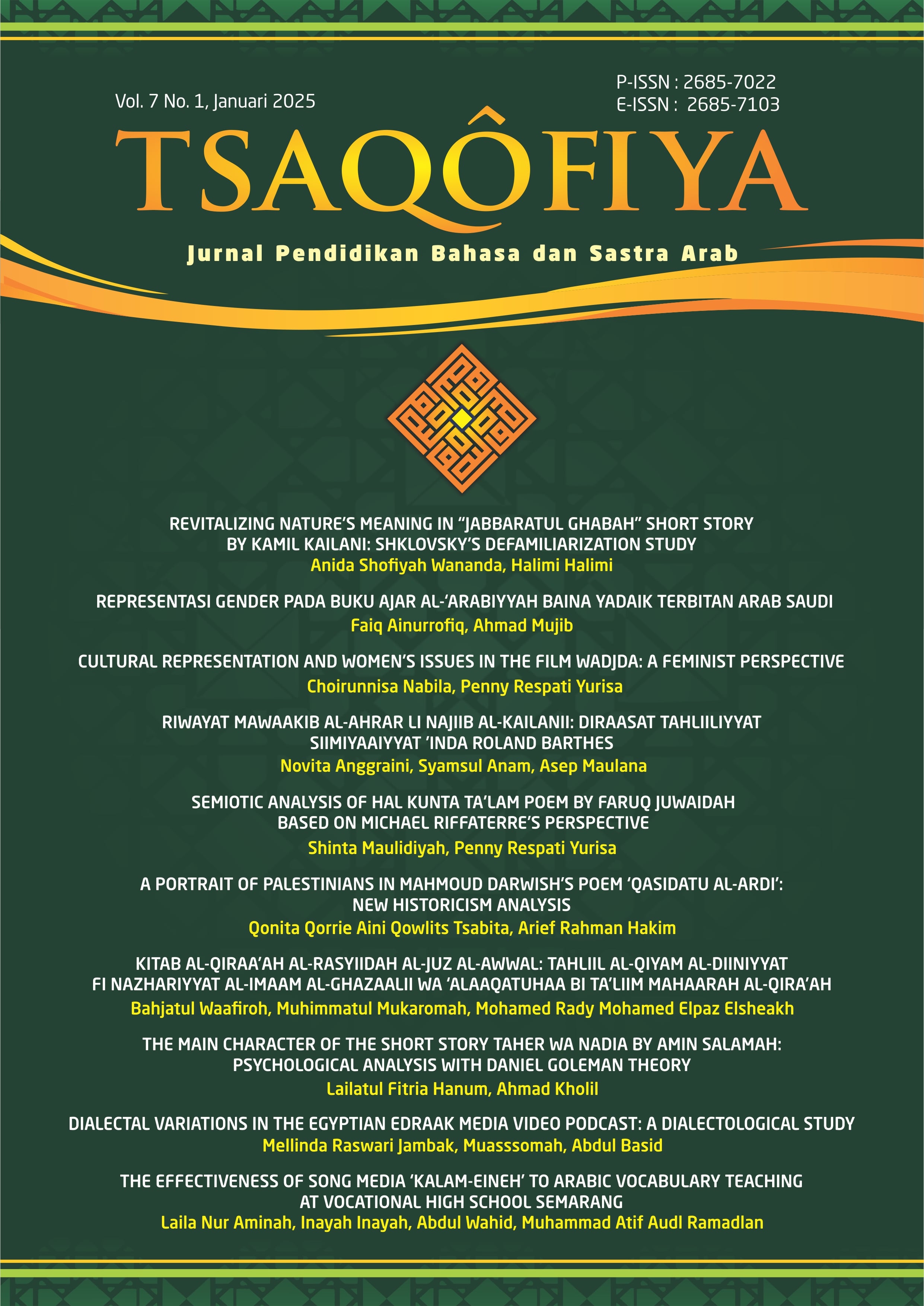
Dialectal Variations In The Egyptian Edraak Media Video Podcast: A Dialectological Study
DOI:
https://doi.org/10.21154/q5hx1v69Keywords:
Egyptian Dialect, Phonology, Morphology, Edraak Media PodcastAbstract
Dialectal variations reflect the richness of culture and the identity of communities, particularly in Arabic, which encompasses a wide range of dialects. This study focuses on the phonological and morphological variations in the Egyptian Amiyah dialect as used in the Edraak Media podcast, specifically the episode "الأمومة وسنينها مع مي إبراهيم" (Motherhood and Its Years with Mai Ibrahim). The aim of this research is to uncover the forms of dialectal variation in a digital context. The study employs a descriptive qualitative method. Primary data include podcast transcripts and audio content, while secondary data are drawn from relevant literature. Data collection is carried out through observation and note-taking, followed by analysis based on the Miles and Huberman model, which involves data reduction, data presentation, and conclusion drawing. The study refers to dialectology theory, which examines linguistic variations based on geographical and social aspects. The findings reveal 24 phonological variations, such as the change of ج to غ and ق to أ, as well as 27 morphological variations, including the use of the prefix ب for progressive actions and ه for the future tense, the use of مش for negation, irregular verb forms, and functional word forms. These variations reflect linguistic simplification for more efficient everyday communication while simultaneously reinforcing local cultural identity. This research contributes to contemporary linguistic studies, particularly in understanding the dynamics of dialects in the digital era.
Abstrak
Variasi dialek mencerminkan kekayaan budaya dan identitas masyarakat, khususnya dalam bahasa Arab yang memiliki keragaman dialek yang luas. Penelitian ini berfokus pada variasi fonologi dan morfologi dalam dialek Mesir Amiyah yang digunakan dalam podcast Edraak Media, pada episode "الأمومة وسنينها مع مي ابراهيم". Kajian ini bertujuan mengungkapkan bentuk variasi dialek dalam konteks digital. Penelitian ini menggunakan metode kualitatif deskriptif. Data primer berupa transkripsi dan konten audio podcast, sedangkan data sekunder berasal dari literatur yang relevan. Teknik pengumpulan data dilakukan dengan metode simak dan catat, diikuti analisis berdasarkan model Miles dan Huberman, meliputi reduksi data, penyajian data, dan penarikan kesimpulan. Kajian ini mengacu pada teori dialektologi yang meneliti variasi linguistik berdasarkan aspek geografis dan sosial. Hasil penelitian menunjukkan adanya 24 variasi fonologi, seperti perubahan ج menjadi غ dan ق menjadi أ, serta 27 variasi morfologi, seperti penggunaan prefiks ب untuk tindakan progresif dan ه untuk masa depan, penggunaan مش untuk negasi, penggunaan bentuk kata kerja yang tidak teratur, dan penggunaan bentuk kata fungsional. Variasi ini mencerminkan penyederhanaan bahasa demi efisiensi komunikasi sehari-hari, sekaligus memperkuat identitas budaya lokal. Penelitian ini berkontribusi pada studi linguistik kontemporer, khususnya dalam memahami dinamika dialek di era digital.
Downloads
References
Abdussamad, Zuchri. Metode Penelitian Kualitatif. Makassar: Syakir Media Press, 2021.
Agustin, Shelly Retno, Dian Nuzulia Armariena, and Hetilaniar Hetilaniar. “Variasi Dialek Bahasa Jawa Ngoko, Krama Dan Krama Inggil Di Daerah Oku Timur (Kajian Dialektologi).” Indonesian Research Journal on Education 3, no. 2 (March 12, 2023): 980–88. https://doi.org/10.31004/IRJE.V3I2.106.
Al-Batal, Mahmoud. Arabic as One Language: Integrating Dialect in the Arabic Language Curriculum. Washington, D.C.: Georgetown University Press, 2018.
Al-Rubaat, Atalah Mohammad. “The Relationship between the Morphological Phenomena of the Current Sakakan Dialect and the Modern Standard Arabic.” Eurasian Journal of Applied Linguistics 8, no. 1 (2022): 1–12. https://doi.org/10.32601/ejal.911515.
Alhedayani, Rukayah. “The Najdi Arabic Corpus: A New Corpus For An Underrepresented Arabic Dialect.” Language Resources and Evaluation, July 2, 2024, 1–20. https://doi.org/10.1007/S10579-024-09749-5/TABLES/5.
Baal, Yvonne Van, Ragnhild Eik, Hedda Solbakken, and Terje Lohndal. “The Decline of Feminine Gender: A Cross-Dialectal Study of Seven Norwegian Dialects.” Journal of Comparative Germanic Linguistics 27, no. 1 (December 1, 2024): 1–35. https://doi.org/10.1007/S10828-024-09155-9/TABLES/22.
Benali, Abdelhakim, Mohamed Hédi Maaloul, and Lamia Hadrich Belguith. “Automatic Processing of Algerian Dialect: Corpus Construction and Segmentation.” SN Computer Science 4, no. 5 (September 1, 2023): 1–10. https://doi.org/10.1007/S42979-023-02097-1/METRICS.
Dewi, Anita Candra, Andi Jranasti Larashati Muchdy, Veni Kezia Septiani Mael, Muh. Eril Sumardi, Yudhistira Wikrama Desember, and A. Ahmad Nadil. “Peran Bahasa Indonesia Dalam Pembentukan Identitas Nasional.” Argopuro: Jurnal Multidisiplin Ilmu Bahasa 1, no. 3 (November 28, 2023): 11–20. https://doi.org/10.6734/ARGOPURO.V1I3.865.
Doreleijers, Kristel, Joske Piepers, Ad Backus, and Jos Swanenberg. “Language Variation in Dialect-Standard Contact Situations.” Cognitive Sociolinguistics Revisited, November 8, 2022, 175–85. https://doi.org/10.1515/9783110733945-015/PDF.
Ezzine, Abderrahim, Naouar Laaidi, Ouissam Zealouk, and Hassan Satori. “Building Automatic Speech Recognition Systems for Moroccan Dialect: A Phoneme-Based Approach.” SN Computer Science 5, no. 6 (August 1, 2024): 1–10. https://doi.org/10.1007/S42979-024-03108-5/METRICS.
Faheem, Mohamed Atta, Khaled Tawfik Wassif, Hanaa Bayomi, and Sherif Mahdy Abdou. “Improving Neural Machine Translation For Low Resource Languages Through Non-Parallel Corpora: A Case Study Of Egyptian Dialect To Modern Standard Arabic Translation.” Scientific Reports 14, no. 1 (December 1, 2024): 1–10. https://doi.org/10.1038/S41598-023-51090-4/TABLES/4.
Han, Jiatong, Kai Zhang, Han Lin, Le Chang, Juan Tu, and Qiang Mai. “The U-Shape Association between Population Agglomeration and Individual Depression: The Role of Dialect Diversity.” Journal of Urban Health 101, no. 4 (August 1, 2024): 740–51. https://doi.org/10.1007/S11524-024-00890-8/METRICS.
Jbel, Mouad, Mourad Jabrane, Imad Hafidi, and Abdulmutallib Metrane. “Sentiment Analysis Dataset in Moroccan Dialect: Bridging the Gap between Arabic and Latin Scripted Dialect.” Language Resources and Evaluation, September 11, 2024, 1–30. https://doi.org/10.1007/S10579-024-09764-6/TABLES/12.
Joseph, John E., Gijsbert Rutten, and Rik Vosters. “Dialect, Language, Nation: 50 Years On.” Language Policy 19, no. 2 (May 1, 2020): 161–82. https://doi.org/10.1007/S10993-020-09549-X/METRICS.
Levesque, Kyle C., Helen L. Breadmore, and S. Hélène Deacon. “How Morphology Impacts Reading and Spelling: Advancing the Role of Morphology in Models of Literacy Development.” Journal of Research in Reading 44, no. 1 (February 1, 2021): 10–26. https://doi.org/10.1111/1467-9817.12313.
Li, Qiang, Qianyu Mai, Mandou Wang, and Mingjuan Ma. “Chinese Dialect Speech Recognition: A Comprehensive Survey.” Artificial Intelligence Review 57, no. 2 (February 1, 2024): 1–39. https://doi.org/10.1007/S10462-023-10668-0/FIGURES/9.
Lim, Alfred, Beth O’Brien, and Luca Onnis. “Orthography-Phonology Consistency in English: Theory- and Data-Driven Measures and Their Impact on Auditory vs. Visual Word Recognition.” Behavior Research Methods 56, no. 3 (March 1, 2024): 1283–1313. https://doi.org/10.3758/S13428-023-02094-5/TABLES/7.
Miles, Matthew B, A. Michael Huberman, and Johnny Saldana. Qualitative Data Analys: A Methods Sourcebook. Sage Publications, 2013.
Nanda, Fitra, Rika Astari, and Haji Mohammad bin Seman. “The Pronunciation of Egyptian Arabic and Its Aspect of Sociolinguistic.” Jurnal Al Bayan: Jurnal Jurusan Pendidikan Bahasa Arab 12, no. 2 (September 2, 2020): 340–56. https://doi.org/10.24042/albayan.v12i2.5784.
Oneib, Bouchra, Abdelilah El Filali, and Naima Abda. “The Moroccan Dialect Version of the Insomnia Severity Index.” Middle East Current Psychiatry 29, no. 1 (December 1, 2022): 1–6. https://doi.org/10.1186/S43045-022-00182-4/TABLES/5.
Ouisaadane, Abdelkbir, Said Safi, and Miloud Frikel. “An Experiment of Moroccan Dialect Speech Recognition in Noisy Environments Using PocketSphinx.” International Journal of Speech Technology 27, no. 2 (June 1, 2024): 329–39. https://doi.org/10.1007/S10772-024-10103-X/TABLES/5.
Ross, Jory, Kevin D. Lilley, Cynthia G. Clopper, Jennifer S. Pardo, and Susannah V. Levi. “Effects of Dialect-Specific Features and Familiarity on Cross-Dialect Phonetic Convergence.” Journal of Phonetics 86, no. 101041 (May 1, 2021): 1–23. https://doi.org/10.1016/J.WOCN.2021.101041.
Setiawan, Wahyu, Dwi Widayati, and Sugihana Sembiring. “Variasi Leksikal Bahasa Karo Di Kabupaten Karo: Kajian Dialektologi.” Jurnal Kajian Ilmu Pendidikan (JKIP) 5, no. 3 (November 24, 2024): 611–19. https://doi.org/10.55583/JKIP.V5I3.1108.
Shair-Rosenfield, Sarah, Arjan H. Schakel, Sara Niedzwiecki, Gary Marks, Liesbet Hooghe, and Sandra Chapman-Osterkatz. “Language Difference and Regional Authority.” Regional & Federal Studies 31, no. 1 (January 1, 2021): 73–97. https://doi.org/10.1080/13597566.2020.1831476.
Simanullang, Rinawasti, and Muhammad Surip. “ANALISIS SINKRONIK DIALEK BAHASA BATAK TOBA DI BARUS TAPANULI TENGAH : KAJIAN DIALEKTOLOGI.” Jurnal Pendidikan Sosial Dan Humaniora 2, no. 3 (June 25, 2023): 11825–36. https://publisherqu.com/index.php/pediaqu/article/view/404.
———. “Analisis Sinkronik Dialek Bahasa Batak Toba Di Barus Tapanuli Tengah: Kajian Dialektologi.” Jurnal Pendidikan Sosial Dan Humaniora 2, no. 3 (June 25, 2023). https://publisherqu.com/index.php/pediaqu/article/view/404.
Taembo, Maulid. “Variasi Leksikal Bahasa Wakatobi: Kajian Dialektologi (Lexical Variation of the Wakatobi Language: Dialectology Study).” Kandai 19, no. 2 (November 30, 2023): 265–80. https://doi.org/10.26499/JK.V19I2.6017.
Yinon, Rotem, and Shelley Shaul. “Examining the Developmental Trade-off between Phonology and Morphology in Hebrew Reading Acquisition.” Reading and Writing, June 26, 2024, 1–25. https://doi.org/10.1007/S11145-024-10570-3/TABLES/3.
Downloads
Published
Issue
Section
License
Copyright (c) 2025 Mellinda Raswari Jambak, Muasssomah, Abdul Basid (Author)

This work is licensed under a Creative Commons Attribution-ShareAlike 4.0 International License.