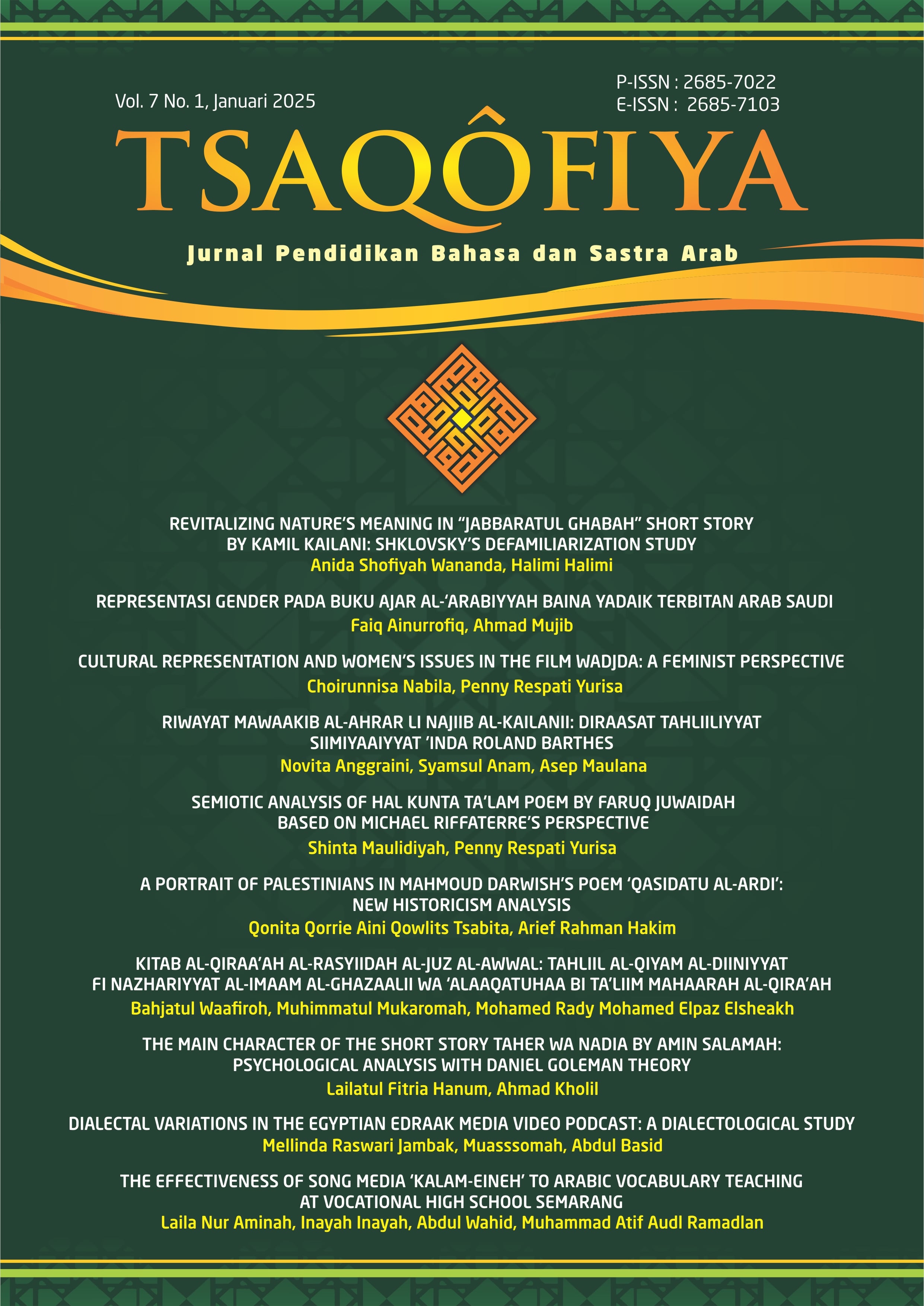
Representasi Gender pada Buku Ajar Al-‘Arabiyyah Baina Yadaik Terbitan Arab Saudi
DOI:
https://doi.org/10.21154/feg4xe42Keywords:
gender construction, textbooks, discrimination, ulama fatwa, ideology, power.Abstract
Textbooks can be one of the means to construct gender roles. Therefore, gender discrimination and equality can be produced and perpetuated through textbooks. This paper wants to examine the construction of the representation of the roles of men and women and the social context surrounding the writing of the textbook al-'Arabiyyah baina Yadaik published in Saudi Arabia. The researcher uses critical discourse analysis to track the representation of the gender division of women and men. Text construction and visualization of male and female roles are analyzed at the macro, meso, and microstructure levels. In the end, the researcher concluded: First, the division of gender roles in the al-'Arabiyyah baina Yadaik textbook is represented in a discriminatory manner. Male gender roles are described as very dominant compared to female roles. The dominance of men over the relationship can be seen at the level of visualization, their role in the family realm, their role in public work, sports activities, and physical activities. Second, the discriminatory depiction of gender roles in the textbook al-'Arabiyyah baina Yadaik is inseparable from the author's social cognition, which is dominantly influenced by the fatwas of Salafi scholars of Saudi Arabia who domesticate the role of women. The access and dominance of strong Salafi scholars in organizing the realm of education in Saudi Arabia affect the construction of discriminatory gender roles, including at the level of textbook preparation.
Abstrak
Buku ajar dapat menjadi salah satu sarana untuk mengkonstruksi peran gender. Oleh karena itu, diskriminasi dan kesetaraan gender dapat diproduksi dan dilanggengkan melalui buku ajar. Tulisan ini hendak mengkaji konstruksi representasi peran laki-laki dan perempuan dan konteks sosial yang melingkupi penulisan buku ajar al-‘Arabiyyah baina Yadaik yang diterbitkan di Arab Saudi. Peneliti menggunakan analisis wacana kritis dalam melacak bentuk-bentuk representasi pembagian peran gender perempuan dan laki-laki. Kontruksi teks dan visualisasi peran laki-laki dan perempuan dianalisa pada level struktur makro, meso, dan mikro. Pada akhirnya peneliti menyimpulkan: Pertama, pembagian peran gender dalam buku ajar al-‘Arabiyyah baina Yadaik direpresentasikan secara diskriminatif. Peran gender laki-laki digambarkan sangat dominan dibandingkan dengan peran perempuan. Dominasi laki-laki atas perepuan tampak pada tataran visualisasinya, perannya dalam ranah keluarga, perannya dalam pekerjaan publik, aktifitas olah raga, dan aktifitas fisik. Kedua, penggambaran diskriminatif peran gender dalam buku ajar al-‘Arabiyyah baina Yadaik tidak terlepas dari relasi kognisi sosial penulis yang secara dominan dipengaruhi oleh fatwa-fatwa ulama Salafi Arab Saudi yang mendomestifikasi peran perempuan. Akses dan dominasi ulama Salafi yang kuat dalam menata ranah pendidikan di Arab Saudi berpengaruh dalam konstruksi peran gender yang diskriminatif termasuk pada tataran penyusunan buku ajar.
Downloads
References
Ainurrofiq, Faiq. “DAWR AL MAR’AH FI AL QITHA’AL’AM: BAYNA FATAWA AL’ULAMA’AL SU’UDIYYIN WA RU’YAH AL MAMLAKAH AL’ARABIYYAH AL SU’UDIYYAH 2030.” PhD Thesis, UIN SUNAN KALIJAGA YOGYAKARTA, 2022. https://digilib.uin-suka.ac.id/id/eprint/53987.
———. “Fatwa Ulama Dan Diskriminasi Perempuan Pada Ranah Pendidikan.” MA’ALIM: Jurnal Pendidikan Islam 5, no. 1 (2024): 14–40.
Al-Atawneh, Muhammad. “Is Saudi Arabia a Theocracy? Religion and Governance in Contemporary Saudi Arabia.” Middle Eastern Studies 45, no. 5 (September 1, 2009): 721–37. https://doi.org/10.1080/00263200802586105.
Alhargan, Raed Abdulaziz. “Saudi Arabia: Civil Rights and Local Actors.” Middle East Policy 19, no. 1 (March 2012): 126–39. https://doi.org/10.1111/j.1475-4967.2012.00529.x.
Al-Kandari, Ali A., and Ali Dashti. “Fatwa and the Internet: A Study of the Influence of Muslim Religious Scholars on Internet Diffusion in Saudi Arabia.” Prometheus 32, no. 2 (April 3, 2014): 127–44. https://doi.org/10.1080/08109028.2014.998929.
AlMunajjed, Mona. Women in Saudi Arabia Today. New York: St. Martin’s Press, 1997.
Al-Qatawneh, Sami, and Ahood Al Rawashdeh. “Gender Representation in the Arabic Language Textbook for the Ninth Grade Approved by the Ministry of Education for Use in Schools in the United Arab Emirates (UAE).” Studies in Educational Evaluation 60 (2019): 90–98.
Al-Rasheed, Madawi. A Most Masculine State: Gender, Politics and Religion in Saudi Arabia. 43. Cambridge University Press, 2013.
Al-Saggaf, Yeslam. “An Exploratory Study of Attitudes Towards Privacy in Social Media and the Threat of Blackmail: The Views of a Group of Saudi Women.” The Electronic Journal of Information Systems in Developing Countries 75, no. 1 (July 2016): 1–16. https://doi.org/10.1002/j.1681-4835.2016.tb00549.x.
Alsahi, Huda. “The Twitter Campaign to End the Male Guardianship System in Saudi Arabia.” Journal of Arabian Studies 8, no. 2 (July 3, 2018): 298–318. https://doi.org/10.1080/21534764.2018.1556871.
Badara, Aris. Analisis Wacana: Teori, Metode, Dan Penerapannya Pada Wacana Media. Prenada Media, 2014.
Baghdadi, Mitra, and Ali Rezaei. “Gender Representation in English and Arabic Foreign Language Textbooks in Iran: A Comparative Approach.” Journal of International Women’s Studies 16, no. 3 (2015): 16–32.
Baki, Roula. “Gender-Segregated Education in Saudi Arabia: Its Impact on Social Norms and the Saudi Labor Market.” Education Policy Analysis Archives 12, no. 28 (June 17, 2004). https://eric.ed.gov/?id=EJ852310.
Barton, Amanda, and Lydia Namatende Sakwa. “The Representation of Gender in English Textbooks in Uganda.” Pedagogy, Culture & Society 20, no. 2 (2012): 173–90.
Bin Bāz, ’Abdul Azīz bin Abdillāh. Fatāwā Nūrun Alā Ad-Darb. Vol. 30. 1. Riyad: al-Ri’asah al-’Ammah li al-Buhuts al-’Ilmiyyah wa al-Ifta’, 2016.
———. Fatāwā Nūrun Alā Ad-Darb. Vol. 31. 2. Riyād: al-Ri’āsah al-’Āmmah li al-Buhūts al-’Ilmiyyah wa al-Ifta’, 2016.
Bligh, Alexander. “The Saudi Religious Elite (ULAMA) as Participant in The Political System of The Kingdom.” International Journal of Middle East Studies 17, no. 1 (February 1985): 37–50. https://doi.org/10.1017/S0020743800028750.
Cummings, Kate. “Invisible Indians: How Political Systems Support the Misrepresentation of Indigenous People’s History and Its Effects on Indigenous Children.” In The New Politics of the Textbook, 259–71. Brill, 2012.
Doumato, Eleanor A. “Gender, Monarchy, and National Identity in Saudi Arabia.” British Journal of Middle Eastern Studies 19, no. 1 (January 1992): 31–47. https://doi.org/10.1080/13530199208705547.
Doumato, Eleanor Abdella. “Women and Work in Saudi Arabia: How Flexible Are Islamic Margins?” Middle East Journal 53, no. 4 (1999): 568–83.
El Fadl, Khaled M. Abou. “Atas Nama Tuhan: Dari Fikih Otoriter Ke Fikih Otoritatif, Terj.” R. Cecep Lukman Yasin. Jakarta: Serambi Ilmu Semesta, 2004.
El‐Sanabary, Nagat. “Female Education in Saudi Arabia and the Reproduction of Gender Division.” Gender and Education 6, no. 2 (January 1994): 141–50. https://doi.org/10.1080/0954025940060204.
Eriyanto. Analisis Wacana: Pengantar Analisis Teks Media. LKiS Yogyakarta, 2001.
Fadaak, Talha H., and Ken Roberts. Youth in Saudi Arabia. Springer, 2018.
Fakih, Mansour. Analisis Gender & Transformasi Sosial (Cet. 14). Yogyakarta: Pustaka Pelajar, 2012.
Fauzan, Abdurrahman Ibrahim. Al-’Arabiyyah Baina Yadaik. Vol. 2. Riyād: al-’Arabiyyah lil-Jāmi’, 2007.
———. Al-’Arabiyyah Baina Yadaik. Vol. 3. Riyād: al-’Arabiyyah lil-Jāmi’, 2007.
Fauzan, Umar. “Analisis Wacana Kritis Dari Model Faiclough Hingga Mills.” Jurnal Pendidik 6, no. 1 (2014).
Fitzgibbon, Linda. “Ideologies and Power Relations in a Global Commercial English Language Textbook Used in South Korean Universities: A Critical Image Analysis and a Critical Discourse Analysis.” Unpublished PhD Dissertation. University of Queensland, 2013.
Hasnah, Nur. “Bias Gender Dalam Buku Ajar Al-Arabiyah Linnaasyiin.” HUMANISMA: Journal of Gender Studies 1, no. 1 (2017): 61–74.
Hodges, Julie. “Cracking the Walls of Leadership: Women in Saudi Arabia.” Gender in Management: An International Journal 32, no. 1 (March 6, 2017): 34–46. https://doi.org/10.1108/GM-11-2015-0106.
Itzin, Catherine, and Janet Newman. Gender, Culture and Organizational Change: Putting Theory into Practice. Psychology Press, 1995.
Izzuddin, Reza Pahlevi Dalimunthe, and Sulistiyono Susilo. “The Portrayal of Women in Arabic Textbooks for Non-Arabic Speakers.” SAGE Open 11, no. 2 (2021): 21582440211014184.
Jam’un Min al-’Ulamā’. Fatāwā Al-Mar’ah al-Muslimah. Vol. 2. Riyad: Maktabah Dār Tayariyah, 1995.
Kamal Eldin Osman Salih. “The Roots and Causes of the 2011 Arab Uprisings.” Arab Studies Quarterly 35, no. 2 (2013): 184. https://doi.org/10.13169/arabstudquar.35.2.0184.
Kattan, Manal Matouq, Carmen De Pablos Heredero, Jose Luis Montes Botella, and Vasilica Maria Margalina. “Factors of Successful Women Leadership in Saudi Arabia.” Asian Social Science 12, no. 5 (April 19, 2016): 94. https://doi.org/10.5539/ass.v12n5p94.
Kobia, John M. “Femininity and Masculinity in English Primary School Textbooks in Kenya,” no. 28 (2009): 15.
Korfiatis, Kostas J., Anastasia G. Stamou, and Stephanos Paraskevopoulos. “Images of Nature in Greek Primary School Textbooks.” Science Education 88, no. 1 (2004): 72–89.
Lazar, Michelle M., ed. Feminist Critical Discourse Analysis. London: Palgrave Macmillan UK, 2005. https://doi.org/10.1057/9780230599901.
Ma, Anne. “A Study of the Shaping of the ‘Emotion and Attitude’Domain in the New English Language Curriculum of China through an EFL Textbook.” Pedagogy, Culture & Society 20, no. 2 (2012): 231–50.
Manchin, David, and Andrea Mayr. How to Do Critical Discourse Analysis. New York: Sage Publications, 2012.
McLoughlin, Linda. A Critical Discourse Analysis of South Asian Women’s Magazines: Undercover Beauty. Palgrave Studies in Language, Gender and Sexuality. London, United Kingdom: Palgrave Macmillan, 2017.
Muassomah, Muassomah, Halimi Halimi, Yasmadi Yasmadi, Helmi Kamal, Hisyam Zaini, and Asyifa Nadia Jasmine. “Gender Inequality in Arabic Textbook: Misrepresentation of Women in Culture and Society.” International Journal of Society, Culture & Language 11, no. 1 (2023): 272–88.
Niblock, Tim. Saudi Arabia: Power, Legitimacy and Survival. 1st ed. Routledge, 2004. https://doi.org/10.4324/9780203572351.
Nicholls, Jason. Methods in School Textbook Research. Citeseer, 2003.
Otterbeck, Jonas. “Wahhabi Ideology of Social Control versus a New Publicness in Saudi Arabia.” Contemporary Islam 6, no. 3 (2012): 341–53.
Pahlevi, Riza. “Analisis Buku Al-‘Arabiyyah Baina Yadaik Jilid I: Tinjauan Komponen Dan Tahap Penyajian Materi Buku Teks Bahasa Arab.” Al-Ittijah: Jurnal Keilmuan Dan Kependidikan Bahasa Arab 12, no. 2 (2020): 157–76.
Pharaon, Nora Alarifi. “Saudi Women and the Muslim State in the Twenty-First Century.” Sex Roles 51, no. 5–6 (2004): 349–66.
Porat, Dan A. “It’s Not Written Here, but This Is What Happened: Students’ Cultural Comprehension of Textbook Narratives on the Israeli–Arab Conflict.” American Educational Research Journal 41, no. 4 (2004): 963–96.
Risager, Karen. “Language Textbooks: Windows to the World.” Language, Culture and Curriculum 34, no. 2 (2021): 119–32.
Shodiq, Muhammad Jafar. “Perspektif Kesetaraan Gender Dalam Buku Bahasa Arab Siswa MTs Pendekatan Saintifik 2013.” FENOMENA 8, no. 1 (2016): 01–18.
Song, Juyoung. “‘She Needs to Be Shy!’: Gender, Culture, and Nonparticipation Among Saudi Arabian Female Students.” TESOL Quarterly 53, no. 2 (June 2019): 405–29. https://doi.org/10.1002/tesq.488.
Syarifah, Syarifah. “Analisis Seleksi Dan Gradasi Materi Buku Teks Al-Arabiyyah Baina Yadaik.” Sustainable Jurnal Kajian Mutu Pendidikan 3, no. 1 (2020): 35–54.
Syed, Jawad, Edwina Pio, Romie Frederick Littrell, and Andy Bertsch. “Traditional and Contemporary Status of Women in the Patriarchal Belt.” Equality, Diversity and Inclusion: An International Journal, 2013.
Teitelbaum, Joshua. “Dueling for ‘Da’wa’: State vs. Society on the Saudi Internet.” Middle East Journal 56, no. 2 (2002): 222–39.
Thompson, Mark C. “Saudi Women Leaders: Challenges and Opportunities.” Journal of Arabian Studies 5, no. 1 (January 2, 2015): 15–36. https://doi.org/10.1080/21534764.2015.1050880.
Ulrichsen, Kristian Coates, and Annelle R. Sheline. “Mohammed Bin Salman and Religious Authority and Reform in Saudi Arabia.” Baker Institute Report 9 (2019).
Ulum, Ömer Gökhan, and Dinçay Köksal. Ideology and Hegemony of English Foreign Language Textbooks: Globally and Locally Written Practices. Springer Nature, 2020.
‘Utsaimīn, Muhammad al-Shālih al-. Fatāwā Nūrun Alā Ad-Darb. Vol. 11. Mamlakah ’Arabiyyah as-Su’udiyyah: Mu’assasatu al-Syaikh Muhammad bin Shālih al-‘Utsaimīn, 2003.
Van Dijk, Teun A. “Aims of Critical Discourse Analysis.” Japanese Discourse 1, no. 1 (1995): 17–28.
———. “Discourse and Manipulation.” Discourse & Society 17, no. 3 (2006): 359–83.
———. “Principles of Critical Discourse Analysis.” Discourse & Society 4, no. 2 (April 1993): 249–83. https://doi.org/10.1177/0957926593004002006.
Van Leeuwen, Theo. Discourse and Practice: New Tools for Critical Discourse Analysis. Oxford Studies in Sociolinguistics. Oxford ; New York: Oxford University Press, 2008.
Weninger, Csilla. “Textbook Analysis.” Chapelle CA (a Cura Di), The Encylopedia of Applied Linguistics, Wiley & Sons, Hoboken, 2018.
Wodak, Ruth, Paul A. Chilton, and Wodak-Chilton, eds. A New Agenda in (Critical) Discourse Analysis: Theory, Methodology, and Interdisciplinary. Discourse Approaches to Politics, Society, and Culture 13. Amsterdam: Benjamins, 2005.
Zagumny, Lisa, and Amanda B. Richey. “Textbook Orientalism: Critical Visuality and Representations of Southwest Asia and North Africa.” In The New Politics of the Textbook, 195–213. Brill, 2012.
Zuhdi, M. Nurdin. “Perempuan Dalam Revivalisme (Gerakan Revivalisme Islam Dan Politik Anti Feminisme Di Indonesia).” Musawa Jurnal Studi Gender Dan Islam 9, no. 2 (2010): 237–57.
Downloads
Published
Issue
Section
License
Copyright (c) 2025 Faiq Ainurrofiq, Ahmad Mujib (Author)

This work is licensed under a Creative Commons Attribution-ShareAlike 4.0 International License.